Modeling 50 Myr of Pyrenean Range formation
Over the years, studies of the Pyrenees have sparked debate due to ongoing uncertainties regarding the deep structure of the orogenic prism and the plate kinematic framework. Furthermore, the presence of an HT–LP metamorphic belt and numerous mantle peridotite bodies made interpreting the initiation and formation of this orogen more challenging than expected (e.g., Lagabrielle et al., 2016). The application of modern concepts of continental margin inversion and the consideration of the role of surface processes have redefined our understanding of the tectonic evolution of the range, carrying profound implications for pre-orogenic reconstructions. Models of the evolution of the Pyrenean orogeny now attempt to account for the interaction between Cretaceous hyperextension, which gave rise to the Pyrenean–Bay of Biscay rif, and the main compressional inversion phase that occurred between the late Santonian and the early Miocene (e.g., Teixell et al., 2018).
We decided to use this compelling natural example for teaching plate tectonics and lithosphere deformation mechanisms, through a yearly analog modeling challenge supervised by S. Dominguez. The objectives were to let the students define the initial stage, lithospheric rheology, and boundary conditions, and observe how their Pyrenean model evolved through time.
PYRENEX 2021: FIRST TRY !
In 2021, we launched the inaugural edition of what has since become an annual challenge for Master’s students interested in analog modeling. The pioneer students were: Damien Marion, Maxime Jamet, Youcef Amrane
General comment on the 2021 experiment: This experiment was a great success, considering that it was a first attempt! The tectonic inversion of the rifted domains and the formation of an antiformal stack were clearly the most interesting features to emerge.
PYRENEX 2023:
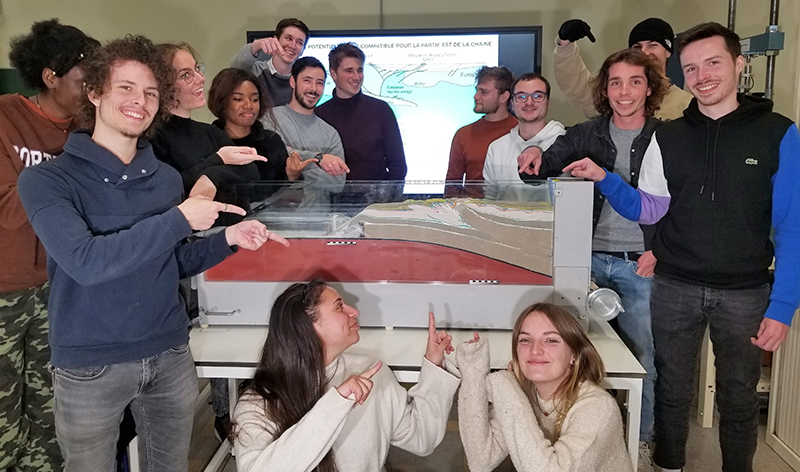
The Master’s students were: Nicolas Afanassieff, Lukas Bernier, Paul Coutable, Salamata Thierno Diallo, Ulysse Froger, orlann Gast, Seydina Goudiaby, Emma Le Gall, leilou Mare, Aimée Pellissier-Tanon, Cyprien Peltier, Jérémie Rinaudo, Mathis Rouchereau, Manaarii Salmon, Aurélien Schweitzer, Aurélien Tricot
General comment on the 2023 experiment: Continental subduction of the Iberian plate was forced, as in the 2021 experiment, but this time part of the lithospheric mantle was trapped in the core of the orogenic wedge. Final stage resembles the western part of the chain. Interesting !
PYRENEX 2024:
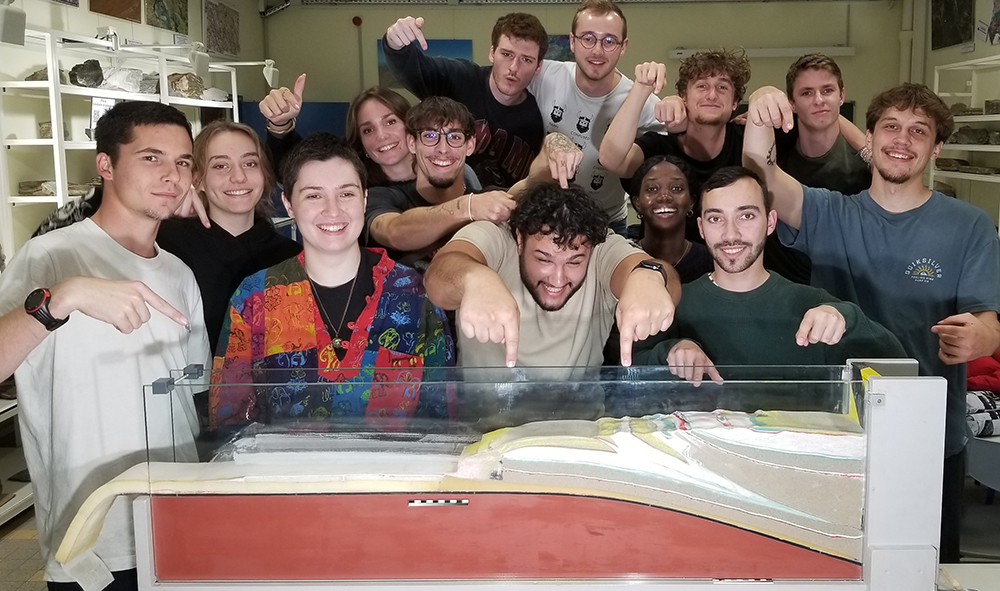
This new generation was composed by: Louanne Aunis, Loriel Brignon, Noé Brossamain, Alexandre Caplette, Valentin Duhard, Baptiste Lacoste, Timothé Mariller, Romane Merten, Anathacie Mingou, Jarod Nichele, Antoine Picur, Benjamin Simiand, Hector Swertvaegher, Louise Vignaud.
General comment on the 2024 experiment: Same general boundary conditions as for the 2021 and 2023 experiments. This time, the students attempted to include an isostatic response to the thickening of the orogenic wedge by adding a foam layer to the base of the lithospheric mantle. Unfortunately, the foam was too weak and the subsidence occurred immediately after the experiment began, increasing a lot the volume of subducting material. Consequently, the Spanish continental margin was dragged down to great depths. A very interesting experience, in any case!
PYRENEX 2025:
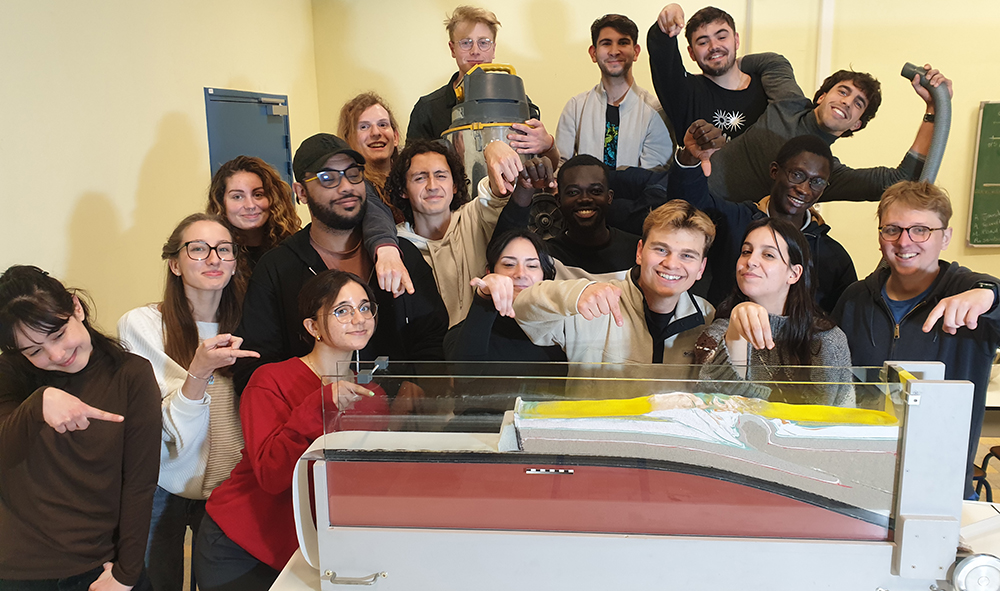
The new generation: Clément Alventosa, Melila Ait Ameur, Francisco Arbilla, Robin Champeau, Omar Chebbi, Mathis Diroff, Nathan de Fosset, Coraline Gautheron, Victoire de Gouzillon de Blizal, Joffrey Laroche, Sophie Hernandez, Kilian L’Hour, Yerim Mbengue, Oriane Leger, Franciszek Peski, Milena Sanz, Paul Vieux Sarr.
General comment on the 2025 experiment: The students decided to keep the initial structure and rheology used by their predecessors. They improved the setup of the weak zones inherited from the Variscan orogeny, refined the rheology of the syn- and post-rift sedimentary cover, and enhanced the structural and mechanical boundary conditions acting on the tip of the European plate. Although the upper continental lithospheric mantle trapped within the core of the range remains oversized, the overall result is highly satisfactory! Bravo !
PYRENEX 2026:
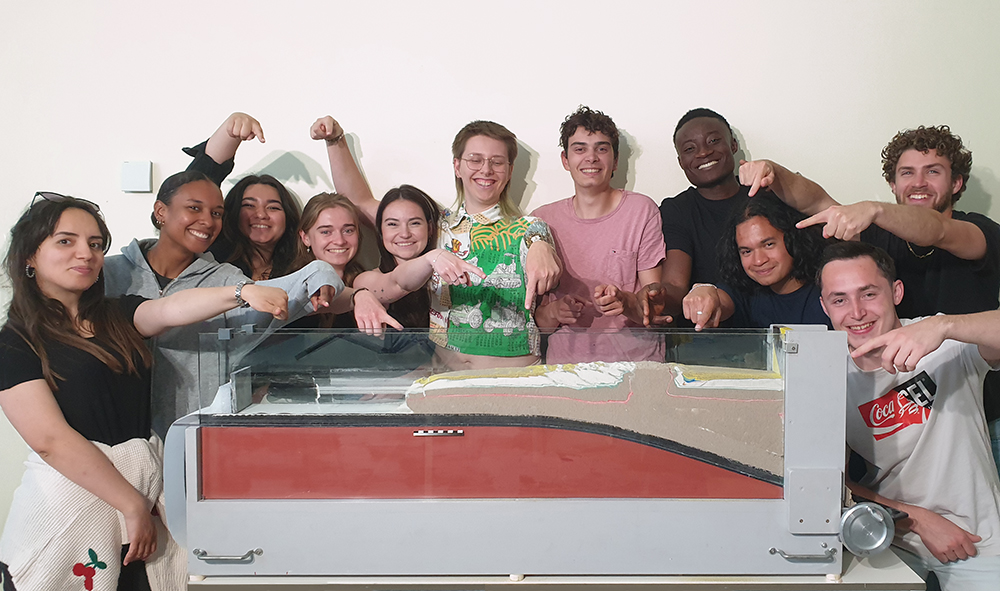
The Master Thesis students who took on the challenge were: Hamdjata Balde, Romain Boqueho, Selja Boulet, Alicia Boyrie, Aliénor Coquillat, Elsa Devos, Nicolas Goutierrez, Sandra Khourta, Nadia Mampouma, Maixent Merlet, Mathis Tost, Frédéric Valencia Ayala.
General comment on the 2026 experiment: A minor mistake during the construction of the initial stage induced a reduction of the available volume of subducting material below the overriding European plate, leading to the incorporation of both the upper and lower crust into the orogenic wedge. Consequently, while the final stage deviated noticeably from the expected result, it provided a good opportunity to discuss the role of deep processes in controlling deformation partitioning within the orogenic prism.
Useful references:
-> , , , , , , , , , and , 1989. Ecors deep seismic data and balanced cross sections: Geometric constraints on the evolution of the Pyrenees, Tectonics, 8(1), 41–50, doi:10.1029/TC008i001p00041. -> PDF
-> Lagabrielle, Y., de Saint Blanquat, M., Godard, M., 2016. From rifting to mountain building: The Pyrenean Belt, Comptes Rendus Geoscience. 348. 169-171. 10.1016/j.crte.2016.04.002. -> PDF
-> Teixell, A., Labaume, P., Ayarza, P., Espurt, N., de Saint Blanquat, M., Lagabrielle, Y., 2018. Crustal structure and evolution of the Pyrenean-Cantabrian belt: A review and new interpretations from recent concepts and data, Tectonophysics, Volumes 724–725, Pages 146-170, ISSN 0040-1951, https://doi.org/10.1016/j.tecto.2018.01.009. -> PDF
-> Muñoz, J., Mencos, J., Roca, E., Carrera, N., Gratacós, O., Ferrer, O., Fernández, O., 2018. The structure of the South-Central-Pyrenean fold and thrust belt as constrained by subsurface data. Geologica Acta. 16. 439-460. 10.1344/GeologicaActa2018.16.4.7.
-> Jourdon, A., Le Pourhiet, L., Mouthereau, F., Masini, E., 2019. Role of rift maturity on the architecture and shortening distribution in mountain belts, Earth and Planetary Science Letters, Volume 512, 2019, P.89-99, ISSN 0012-821X, https://doi.org/10.1016/j.epsl.2019.01.057. -> PDF
-> , , . , 2019. Salt décollement and rift inheritance controls on crustal deformation in orogens. Terra Nova. 2019; 31: 562–568. https://doi.org/10.1111/ter.12428
-> Jourdon, A., Mouthereau, F., Le Pourhiet, L., Callot, J.-P., 2020. Topographic and Tectonic Evolution of Mountain Belts Controlled by Salt Thickness and Rift Architecture. Tectonics, 2020, 39 (1), e2019TC005903. https://doi.org/10.1029/2019TC005903. hal-02529936. -> PDF
-> Laurent, J., Romagny, A.Christian Gorini, Agnès Maillard, Isabelle Thinon, Renaud Couëffé, Maxime Ducoux, Michel Séranne, 2020. Fast dismantling of a mountain belt by mantle flow: Late-orogenic evolution of Pyrenees and Liguro-Provençal rifting, Tectonophysics, Volume 776, 228312, ISSN 0040-1951, https://doi.org/10.1016/j.tecto.2019.228312. -> PDF
-> Ford, M. et al., 2022. Evolution of a low convergence collisional orogen: a review of Pyrenean orogenesis, BSGF – Earth Sci. Bull., 193, 19, https://doi.org/10.1051/bsgf/2022018
-> Pedrera, A., García-Senz, J., Pueyo, E., L., López-Mir, B., Silva-Casal, R., Díaz-Alvarado, J., 2023. Inhomogeneous rift inversion and the evolution of the Pyrenees, Earth-Science Reviews, Volume 245, 104555, ISSN 0012-8252, https://doi.org/10.1016/j.earscirev.2023.104555.
-> Cochelin, B., Denèle, Y., Saspiturry, S., 2025. West European Variscan Belt dismantling and early fragmentation of Pangea: The key role of the Paleotethys subduction, Earth-Science Reviews, Volume 271, 105304, ISSN 0012-8252, https://doi.org/10.1016/j.earscirev.2025.105304.
-> Issautier, B., Saspiturry, N., Angrand, P., Lasseur, E., Andrieu, S. and Robin, C. , 2026. 3D Quantification of Subsidence During Pyrenean Retro-Wedge Initiation: Role of Structural and Thermal Inheritance on Hyperextended Margin Inversion (Aquitaine Basin). Terra Nova, 38: 130-140. https://doi.org/10.1111/ter.70023